
How it works
Four stages that turn learning into practice at work.
Leaders know what to practise, get the right things to practise, get the chance to practise in real work, and see what changed.
28 days free. No credit card. No automatic subscription. You decide whether to continue.
The Trust Journey
Four stages. Each one matters.
Practice only changes things when leaders know what to practise, have the right things to practise, get the chance to practise, and see what changed. Skip a stage and the practice drifts.
The leader doing the trust work moves through all four stages. As the L&D lead, learning provider or coach, you support them through it.
01Identify
Know what to practise.
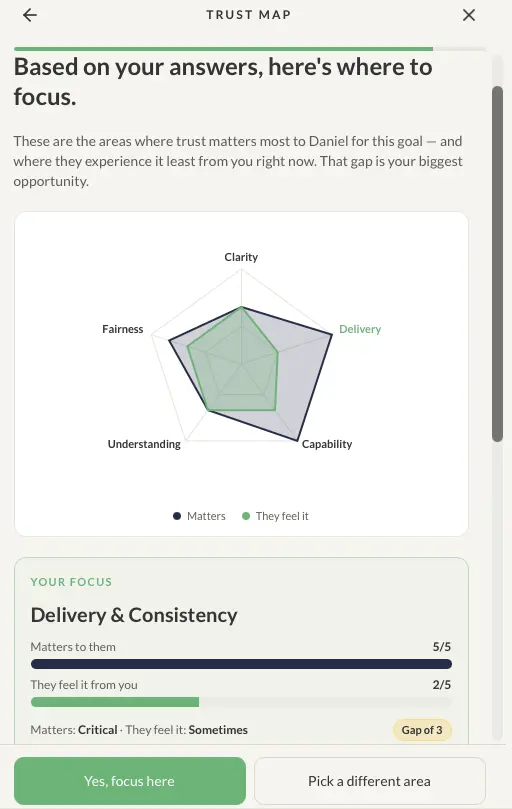
Start with the right focus. The Self-Assessment shows which of the 20 behaviours a leader does least often, in general. A Trust Map looks at one working relationship, and where that person's confidence may be thinner than the leader thinks.
In the example, Maya maps her sponsor, Daniel, and chooses Flag It Early.
What this gives you: One clear behaviour to work on, chosen for a reason.
Trust Map result 02Design
Get the right things to practise.
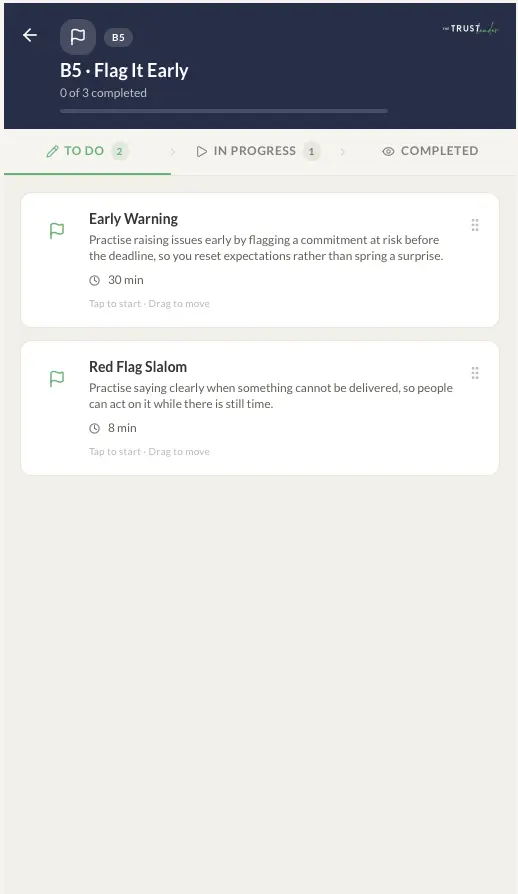
A Behaviour Playlist turns that behaviour into short activities, in a sensible order, written to fit a busy week. Leaders choose the ones that fit their situation, and nobody has to write a programme.
What this gives you: Practice that fits the leader's real work.
Behaviour Playlist 03Practise
Get the chance to practise, in real work.
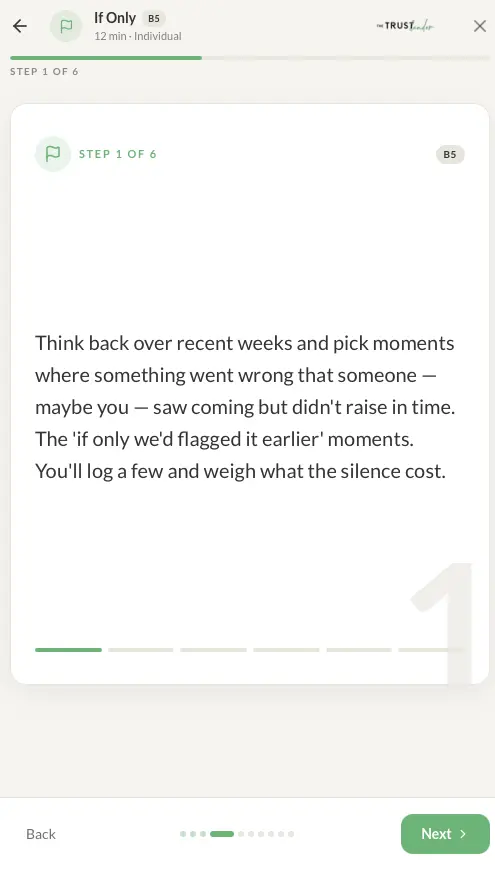
Each activity is a prompt to act in the real relationship: a meeting, an update, a decision. Reminders and check-ins bring leaders back over the following weeks, so the practice does not stop when the session ends.
Maya raises a risk while Daniel still has choices.
What this gives you: Practice that happens at work, not on a screen.
Activity practice 04Reflect
See what changed.
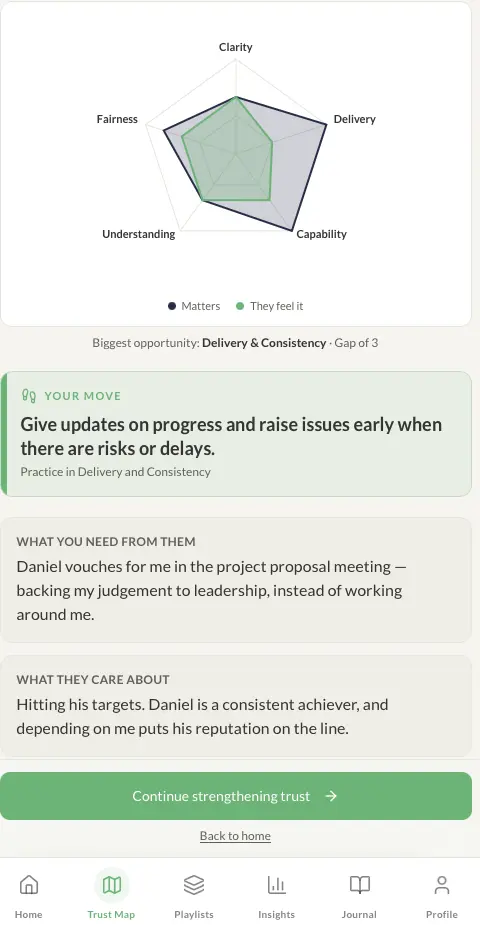
After each activity the leader notes what happened. With a Trust Map, they re-score the same relationship around day 14. With the Self-Assessment, they retake all 20 behaviours after at least 30 days. The Trust Journey report brings it together for a review. Leaders stay in control of what they share.
What this gives you: A dated record of practice and change, in the leader's own words.
See Reflect in the Hub →Download a sample Trust Journey (PDF)
Return to the Trust Map
After a couple of weeks, return to the same relationship and questions. Any movement is evidence for a better conversation, not proof or a final verdict.
A straight word about measurement
A baseline, not a verdict.
The Trust Map records one person's structured view of how another may experience them. It is not an objective diagnosis of whether they are trusted. Its value comes from being specific, dated and repeated under the same questions.
Questions answered plainly
Questions people ask about the Trust Journey.
Is the Trust Journey an assessment?
No. The Self-Assessment and Trust Map help a leader decide what to practise. They are the leader's own view, dated so it can be compared later, not a verdict on whether they are trusted.
How long does a Trust Journey take?
Activities take 10 to 15 minutes each and are used in real work over a few weeks. A Trust Map is re-scored around day 14. A Self-Assessment can be retaken after 30 days. Leaders are asked to reflect again at 30 and 60 days.
Who sees what a leader writes?
Trust Maps, Self-Assessment results and activity reflections are shared with the coach or L&D lead by default. The leader can switch sharing off for any reflection. Journal entries start private.
Does it replace our leadership programme?
No. Your sessions set the focus. The Hub carries the practice into the working weeks around them, and gives you a record of what happened.
Start with one relationship
See what your leaders will experience.
28 days free. No credit card. No automatic subscription. You decide whether to continue.