Start with the goal, then the person.
Most goals depend on someone else's support. Name that person before choosing what to change.
Companion to the white paper · Coaching through a trust lens
A way to use the trust lens inside your own coaching. Start with your participant's goal, look at it from the side of the person whose support they need, and follow the change into real work.
28 days free. No credit card. No automatic subscription.
The idea
Most goals depend on someone else's support. Name that person before choosing what to change.
Their support may cost time, effort or risk. Looking from their side changes what your participant needs to offer.
What people do next is the clearest evidence you'll get. Read it alongside what they tell you, across similar situations.
Trust Leader definition Trust is someone's confidence in you with something they care about.
In a coaching conversation
The participant's goal gives the work its purpose. The four stages of the Trust Journey carry it from understanding to practice and back.
"What would success look like in the work, and what would you see?"
"Whose support matters, and why would they want to?"
"If you do this, what would you expect them to do differently?"
Use the behaviour in ordinary work, between sessions.
"What is changing in how they respond, and how has it affected your goal?"
The five Trust Questions
Do they believe what I say?
Do they believe I'll do what I said?
Do they believe I can handle what's needed?
Do they feel I really understand them?
Do they believe I act with their interests in mind?
Try it next session
No software needed. Each step is one question, at one moment, with something to notice.
When: after agreeing the goal.
"Who do you need, and why would they want to?"
Notice: did the conversation move to one named person and their side of it?
When: before agreeing practice.
"If you do this, what would you expect them to do differently?"
Notice: did the participant leave with a behaviour, a real opportunity and a response to look for?
When: the opening minutes.
"What did they do?" before "How did it go?"
Notice: is the participant describing the other person's actions and words, or only their own feelings?
Free download
The five Trust Questions, the four stages with questions for each, and the three steps. Print it and keep it beside you in sessions.
Download the quick guide (PDF)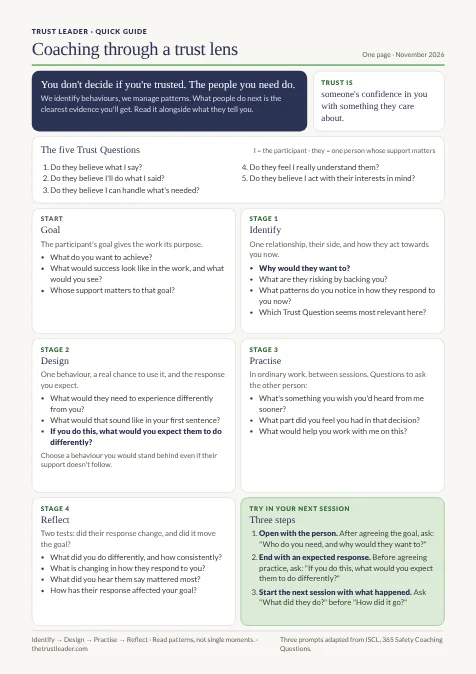 A4 · one page
Illustration · fictional data, not a client result
The free trial is for you. Pick one of your own working relationships, choose one behaviour and practise it for real. Here is what that looks like in the Hub, using a fictional example.
You and the operations lead
Scored 1 (rarely) to 5 (consistently)
What you need from them
His backing for the new scheduling process by March.
What they care about
His team not carrying the blame if it fails.
Biggest gap
Fairness & Consideration
Your Behaviour Playlist
For the behaviour your Trust Map points to
Outcome: you notice where others are affected by a decision before you make it.
Outcome: the people affected get a real say while the plan can still change.
Reflection
How useful was this activity?
★★★★★
When you involved him before deciding, what did you notice?
"He brought two concerns to me first instead of going to the director."
Anything else you noticed? · Optional
Worth watching whether it holds next time.
Who can see this?
Start with yourself
Free for 28 days. Or read the full white paper for the framework, the research and a worked example.
Trust Telegraph
Short, practical thinking for people whose work depends on other people’s confidence.
Examples on this page are fictional. Hub screens are illustrations. Trust Leader makes no claim of demonstrated results. Three coaching prompts in the quick guide are adapted from ISCL, 365 Safety Coaching Questions.