
Start from what they need to practise.
Leaders take the Self-Assessment or map one working relationship that matters. Your session starts from a known focus, not a guess.
For external learning providers
The activities are already written. Nobody on your team has to write content: choose the Behaviour Playlists that match your programme and they are ready to use with a client cohort. Your client commissions the session, and the change they are paying for happens afterwards, at work. The Hub carries your programme into the weeks that follow, and gives you something to report back.
Try it yourself first: 28 days free, no credit card, no automatic subscription.
The problem
Clients often commission a short leadership programme, then expect leaders to apply the learning once you have gone.
Repeated practice in real workplace situations cannot fit inside the room. Without it, useful learning can fade as leaders return to the same relationships and pressures, and the follow-up conversation has little to work with.
Trust Leader gives your programme a workplace-practice phase that carries on after you leave. How to move practice into the workplace.
Where it fits
You choose how much of it to use. Most of the value is in the weeks after you leave.
Leaders take the Self-Assessment or map one working relationship that matters. Your session starts from a known focus, not a guess.
Pick the Behaviour Playlists that match what you teach, so the activities carry your session on rather than starting something new.
Leaders practise in real work, with reminders and check-ins at 14, 30 and 60 days. You get a group report to take back to the client.
How it works for each leader
Each leader follows the four-stage Trust Journey.
Know what to practise. In or after your session, each leader uses the Self-Assessment for the general picture, or the five Trust Questions to read a Trust Map for one relationship, and picks one behaviour.
Get the right things to practise. A Behaviour Playlist gives them short activities for that behaviour.
Get the chance to practise, in real work. They practise it in their own conversations and decisions back at work.
See what changed. They record what happened, giving you and your client something real to review.
See it in the Hub, step by step Check a client programme against the four stages →
For your business
Give clients a structured workplace-practice phase without designing, hosting or maintaining your own system. The activities are already written.
Present the sessions and the practice as one programme, with a clear start, a clear end and the follow-up support you will give.
Use what leaders practised and reported to shape the next conversation with the sponsor, and the next piece of work.
What you get to review
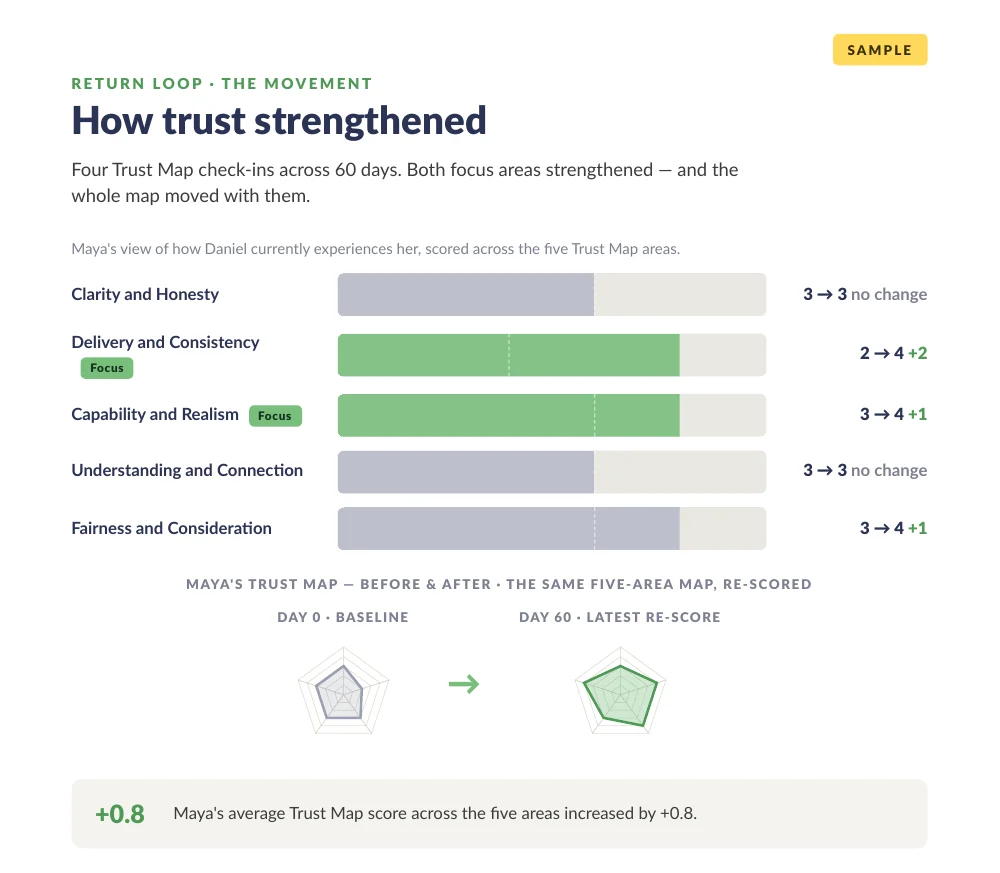
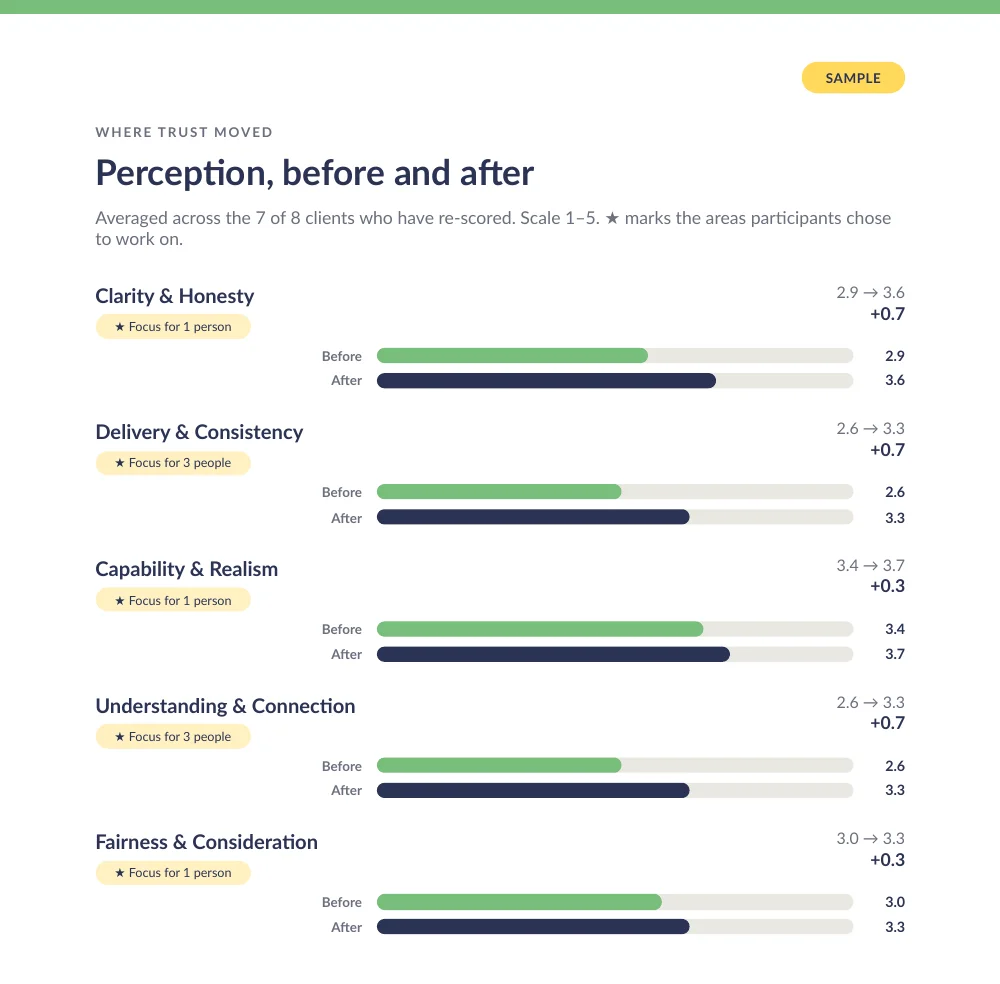
Each leader keeps a Trust Journey: where they started, what they practised and what moved. You get the group view to take back to the client's sponsor. Both come from practice at work, not attendance.
What the Hub does
Everything below works in the Hub today.
An activity takes around 10 to 15 minutes. The leader then has at least 48 hours to try the behaviour at work before they can mark it complete and reflect, so what they write describes what happened when they tried it.
Well-timed emails bring each leader back to practise and reflect, with limits on how often anyone is contacted. Check-ins follow 14, 30 and 60 days after a Behaviour Playlist, and you can send a nudge yourself.
See each leader's progress and their Trust Map, so you know where to spend your support. Reflections are shared with you by default and the leader can switch each one off. Journal entries stay private.
A group report of what people practised, how their own view moved and what they chose to share. No individual rows, names removed from quoted Reflections, and Journal entries never included.
Each leader can download their Trust Journey: where they started, what they practised and what they reported. See a sample (PDF).
As a Practitioner you get your own Trust Maps and Behaviour Playlists, the same as the people you support. Work on the relationships that matter to you while they work on theirs.
In your proposal
Present the facilitated work and the workplace practice as connected parts of one programme. Make the period of practice and Reflection visible to the client, and say what follow-up support you'll give.
Agree up front what the sponsor will see. The group report is designed to be shared; anything about an individual should follow what you agreed and what participants were told.
A pilot with one client cohort is a good way to learn how much participant and facilitator time the practice needs in that setting.
90-day pilot: up to 15 leaders, £295 excl. VAT, credited in full if you continue.
Paid access starts at 5 seats for £75 a month or £750 a year, excl. VAT, and the price per seat falls as you add more. See seat pricing.
Questions answered plainly
Use the time your client commissions to set the focus and introduce the behaviour. In the Hub, each leader finds what to practise, gets short activities for it, practises in real work after your session and records what happened. You review what they report and use it in any follow-up.
No. You keep the professional judgement and the relationship with the client. The Hub supports the practice that cannot fit inside a workshop.
Yes. Present the facilitated sessions and the workplace-practice phase as connected parts of one programme. Say what follow-up support you will give, so the client knows where it starts and ends.
The Cohort Impact Report is built for that: a group view with no individual rows and names removed from quoted Reflections. Anything about an individual depends on what you agreed with the client and what participants were told at the start. Access to the Hub is not, on its own, permission to share.
Yes. Seats are used by active participants, and removing someone frees their seat for the next cohort. Paid access starts at 5 seats for £75 a month or £750 a year, excluding VAT, and the price per seat falls as you add more. For more than 100 seats, talk to us.
Start the free 28-day trial to experience the journey your participants will follow. For a real client programme, talk to us about a 90-day pilot.
Start with one relationship
28 days free. No credit card. No automatic subscription. You decide whether to continue.