
You can leave a session with five things you want to change. Listen more carefully. Be clearer about what you have agreed. Stop saying yes before you have checked whether you can deliver.
All of them may deserve attention. The question is where to start on Monday.
Start with one relationship, and with what you want to be different in the way that person experiences working with you. That gives you a reason to choose one behaviour over another, and something to come back to when you review it.
Why should you work on just one behaviour?
Because with one, you can tell afterwards what your part was.
Change how often you update someone, what goes in the update, and how you ask for their view, all in the same fortnight. Something improves. Now you have three candidates and no way to choose between them.
It won’t prove you caused anything. Their workload might have eased, or a deadline moved. What one behaviour does is make your own part small enough to look at.
One behaviour is not less ambitious. It is the only way to see which change made the difference.
There is a useful finding here. Brown and colleagues compared different kinds of goal across an interpersonal skills programme for 172 managers. Goals framed as the outcome someone wanted transferred better than goals framed as a specific action. It’s one study, in one programme, and it doesn’t settle how many behaviours anyone should practise. What it does is put the order right: name the change you want first, the action second. An action chosen before you know what it’s for is just a resolution.
How do you decide which behaviour to choose?
Start from what you want to be different in one person’s experience of you, not from what you want to improve about yourself.
Trust is someone’s confidence in you with something they care about. So the choice has a direction. What does this person need to rely on you for, and what would you like to change in how that currently feels to them?
“I want to communicate better” leaves that open. “I want them to have the figures in time to check them before the client meeting” doesn’t.
Suppose a colleague depends on your numbers to build a proposal. You could ask more questions, explain your working, or send more updates. Which would help? It depends entirely on what’s getting in their way. Perhaps they understand the figures but get them too late to check anything. Perhaps the figures arrive on time and nobody explains what changed. Those need different actions, and you can’t tell which from the outside.
So ask. “What do you need from me to make this usable?” Then listen to the answer, including the part that changes your view of the problem.
If you already have feedback, start there. Somebody has told you they need earlier notice, or a straighter answer, or to be allowed to finish. If all you have is an impression, keep it as an impression until you can check it. “They asked me twice for an update” is a description of what happened. “They don’t trust me” is your reading of it, and there are other reasons people ask twice.
The five Trust Questions are a way of narrowing where the doubt actually sits. You’re not working on all five. You’re choosing the one that matters to this person, in this situation, and checking what you’re basing that on.
What makes a behaviour specific enough to practise?
Three tests. You can do it without anyone’s permission. The other person would notice it. And there’s an occasion coming up where it applies.
“Be a better listener” fails all three. It leaves everything to be decided once the conversation has already started.
Letting someone finish before you reply passes. So does saying back the concern you think you heard. Both are things you do, at a moment you can recognise, that the other person experiences directly.
Keep the action inside your own control. “Get them to open up” depends on their decision, not yours. Asking an open question and then waiting is yours. What they choose to say is still theirs.
Watch for several changes hiding in one sentence. “I’ll listen, ask better questions, show more empathy and follow up properly” is four commitments and no focus. If the real problem is that you answer before people have finished, start with letting them finish.
Choosing one focus doesn’t excuse the rest of your job. You still keep your commitments, deal with problems and treat people fairly. This is the behaviour you’re deliberately paying attention to while you do all of that.
Once you have it, decide where and when you’ll use it before you leave the session.
How do you choose when two behaviours would both help?
Take the one you’ll get to use soonest.
Start with relevance. Does the action deal with something the person has actually described, or something you have good reason to check? More frequent updates won’t help somebody who is waiting on a decision. More questions won’t help somebody who has already answered and is waiting for you to act.
Then look at opportunity. Where in the next two weeks could you use this? A handover coming up gives you a chance to set an expectation clearly. A conversation about workload gives you a chance to check your understanding before offering a solution.
Then ask whether you can actually do it, with the skill, time and authority you have. If you can’t, say so and name what you need. Rehearsing the wording, getting clear on what you’re allowed to decide, or booking the conversation are all legitimate first moves.
When two look equally promising, opportunity is the tie-breaker. You can learn something from an attempt this week. You learn nothing from a behaviour reserved for a meeting that may never happen.
Small doesn’t mean easy. It means manageable enough to actually do, while still dealing with the thing that matters. A conversation you’ve been avoiding because you don’t know how to start it counts as small.
What does practising one behaviour actually look like?
Here is a worked example, followed through a single 28-day cycle. The people and the data are invented.
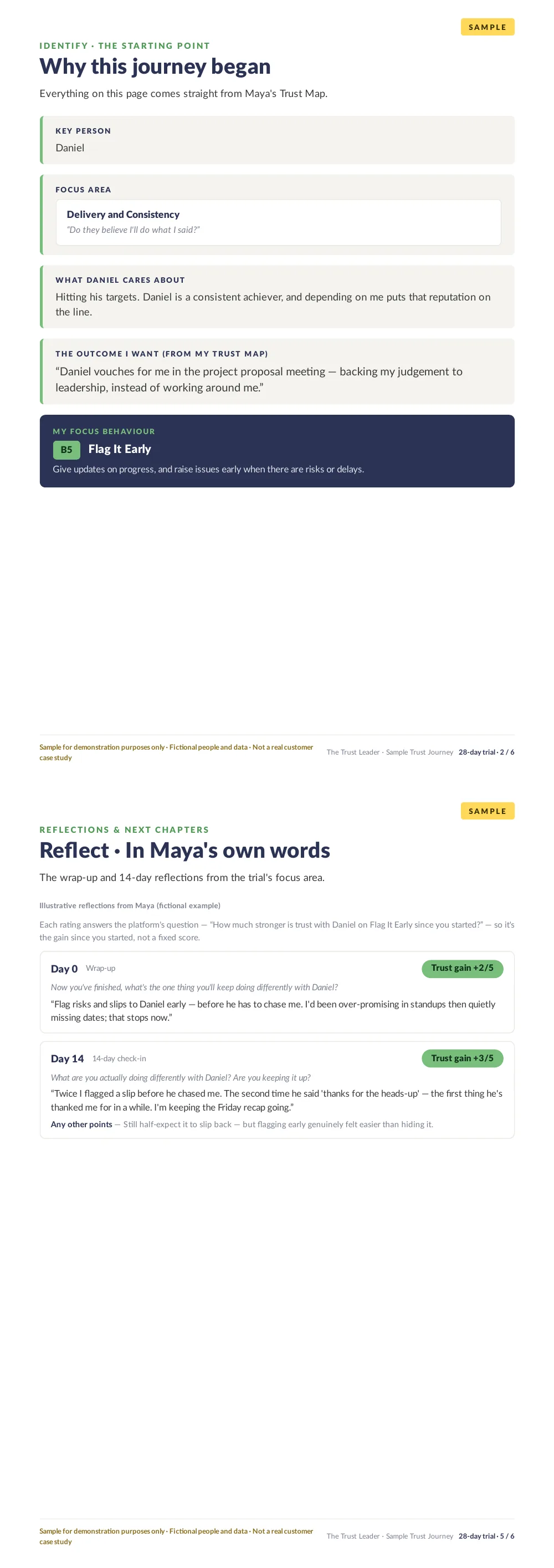
Maya chose one person, Daniel. What he cares about, in her words: hitting his targets, and depending on her puts that on the line. The change she wanted, written down on day one: “Daniel vouches for me in the project proposal meeting”. The doubt sat in Delivery and Consistency, the area behind the question “Do they believe I’ll do what I said?”. Her behaviour was Flag It Early: give updates on progress, and raise issues early when there are risks or delays.
Then three occasions to use it, each followed by a note straight afterwards and another a week later. After the first: counting them up was uncomfortable, three “if only I’d flagged it” moments in a fortnight, all with Daniel. After the second, a week on: “Flagged risks early three times this week. Daniel’s stopped asking me ‘are you sure?’ on dates.”
At fourteen days she wrote: “Twice I flagged a slip before he chased me. The second time he said ‘thanks for the heads-up’.”
Notice the line running through it. What she wanted on day one and what she describes at day fourteen are the same thread, and it’s legible because there was only one. Had she also been working on listening and on saying no, the same fortnight would have produced the same good moment with no way of saying what led to it.
How do you know whether it worked?
Three kinds of evidence come out of this, and the most useful one is a sentence rather than a number.
What they now do or say differently is the strongest thing you’ll have. Daniel stopped asking “are you sure?” about dates. That’s specific, dated, and about him rather than about how you feel.
What you did, and when comes next. It shows you applied the behaviour. It doesn’t show it landed.
The score is the weakest, which surprises people, because it’s the only one that looks like measurement. Maya’s Trust Map moved from 2 to 3 on her focus area. That is Maya’s view of how Daniel experiences her, scored by Maya, twice. Nobody asked Daniel.
So this is a dated, specific, self-reported account. Far more than most people have a fortnight after a course, and not the same as watching somebody’s behaviour towards you change.
If the change you hoped for hasn’t appeared, that’s information rather than failure. Perhaps the occasion never came. Perhaps you used the behaviour but the timing made it useless. Perhaps you chose something that doesn’t address the real problem, in which case choose again, on the evidence, not because the first one felt awkward.
What does this give coaches and L&D?
A dated account of what one person applied, with one named relationship attached to it, which is more than most training leaves behind.
The arc runs across four points. On finishing: what will you keep doing differently with this person? At fourteen days: are you actually doing it, and are you keeping it up? At thirty days: what’s starting to change in how they respond to you? At sixty days: what do they now do or say differently? In Kirkpatrick’s terms that’s reaction and learning, then early behaviour, then behaviour, then results, which is the sequence most programmes claim and few can show.
All four points are the person’s own account, and there’s no independent view anywhere in it.
That’s where your job starts. Turning a reported change into a confirmed one needs a second account, from a colleague or from watching the person at work. No document does that on its own, and the ones that pretend to are why people distrust this kind of evidence. What you get here is a specific, dated claim worth testing, and a next conversation with something real in it.
When one behaviour is not enough
Sometimes the difficulty isn’t behavioural, and practising won’t touch it. If somebody can’t rely on you because the work is genuinely undeliverable in the time, or because nobody has decided who owns it, name that instead. A well-practised update doesn’t fix an unmade decision.
And a single behaviour practised carefully alongside missed commitments elsewhere won’t read as change. It’ll read as a technique.